
The Challenge
Painted cream, the bookcases read as an extension of the wall behind them. The shelves held books, the bases held storage, and none of it registered as architecture — the fireplace was doing all the work in the room alone.
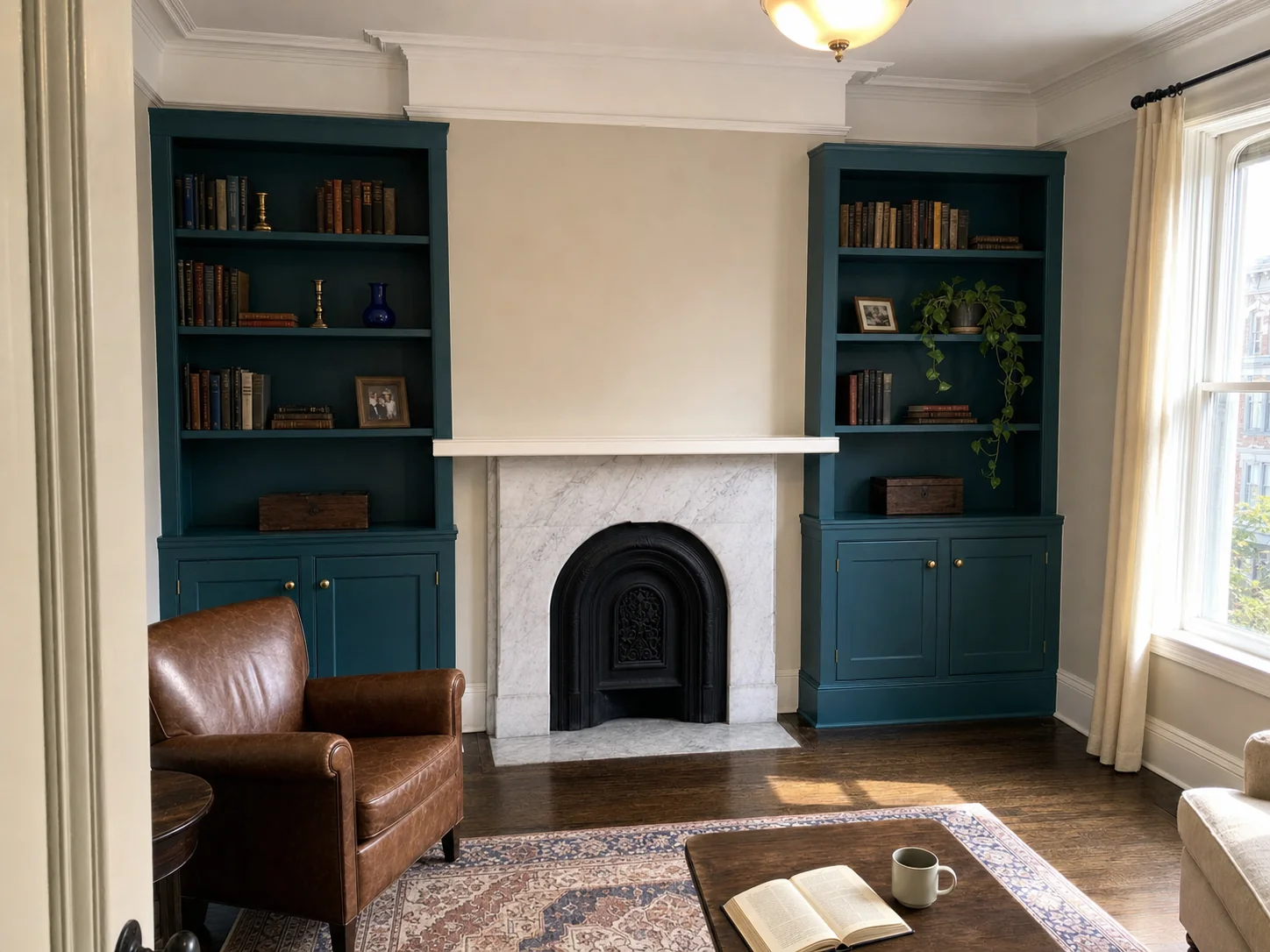
Painters DC repainted the twin library built-ins in this Logan Circle, Washington DC rowhouse parlor, taking the cream bookcases to a deep teal. The millwork was sound and original to the room, so painting the existing built-ins was the honest choice over rebuilding them.
Twin built-in bookcases flanking an arched marble fireplace. The joinery was sound; the finish made them disappear.
A rowhouse parlor library — see painting services in Logan Circle.
Shelves, cabinet bases, face frames, and the surrounding millwork.
Cream gave way to a deep teal across every visible built-in surface.
The arched marble fireplace and mantel, the crown moulding profile, and the books.
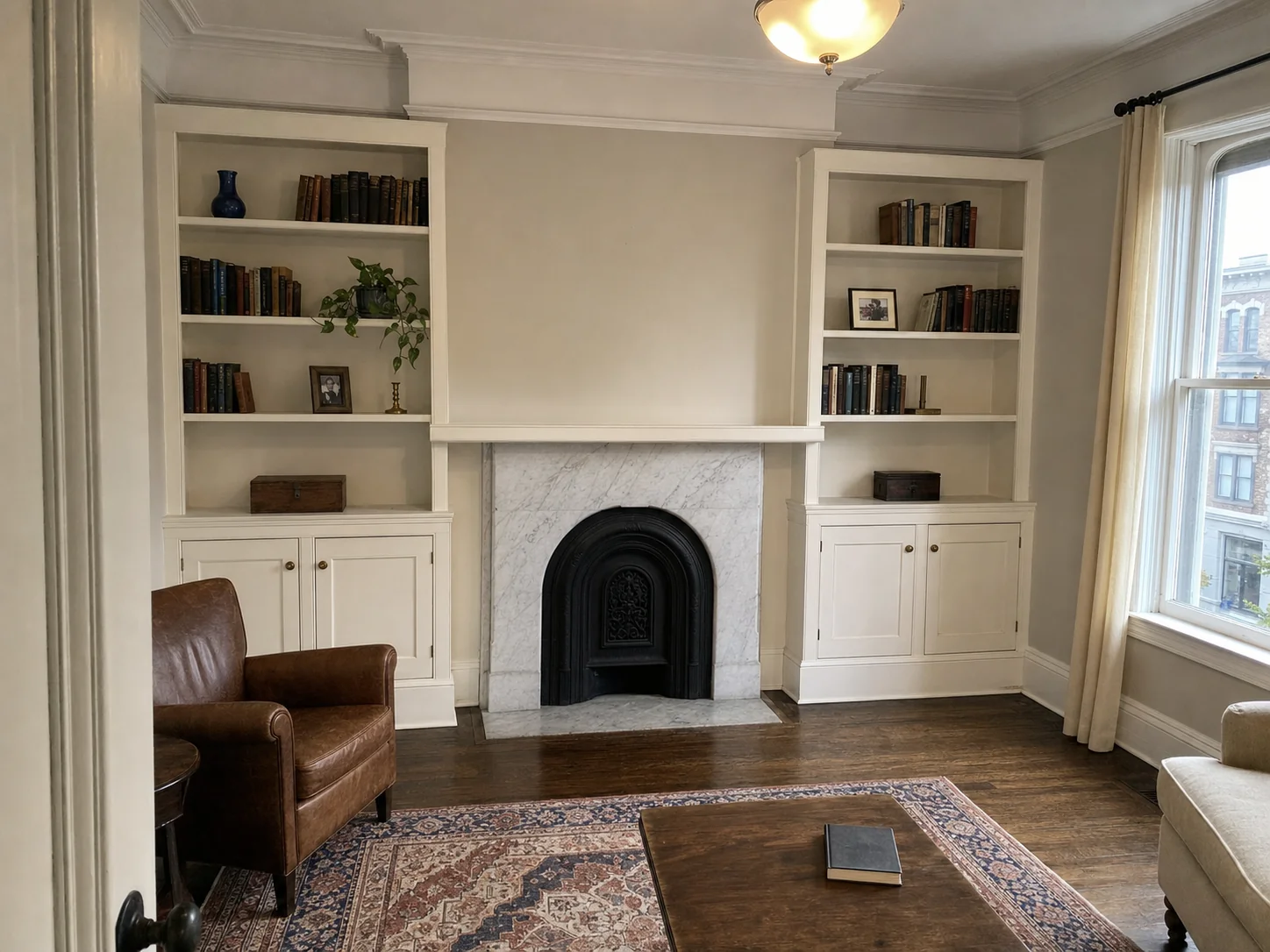
Same room, same joinery, same layout — the finish is what changed.
Custom joinery is expensive to replace and slow to reproduce. Here it did not need replacing — it needed to stop disappearing.
Painted cream, the bookcases read as an extension of the wall behind them. The shelves held books, the bases held storage, and none of it registered as architecture — the fireplace was doing all the work in the room alone.
Rebuilding built-ins means demolition against plaster, new joinery scribed to an old wall, and weeks of a parlor out of use. The existing carcasses, shelves, and face frames were sound, so the project became a finish project — the same reasoning behind cabinet and built-in refinishing in Washington, DC.
Shelves were emptied and the units prepared for a furniture-grade finish: surfaces cleaned and sanded, cut lines set against the wall and the crown, and a deep teal carried across shelving, bases, and frames. The marble surround and mantel were left alone, as was the crown moulding. Choosing a saturated color for a north-facing parlor is exactly what a color consultation settles in the room itself.
The built-ins now frame the fireplace instead of hiding beside it. Book spines stand out against the dark field, the marble and crown read brighter by contrast, and the parlor gained architecture without gaining a renovation.
As general guidance rather than a claim about any one job: when built-in carcasses, shelves, and frames are structurally sound, refinishing them is usually the better trade than replacing custom joinery.
Painting built-ins sits inside the wider scope of interior painting in Washington, DC, where walls, trim, and joinery are planned together rather than piecemeal.
Book a free consultation →Built-ins are inspected at arm's length, every day, by the people who live with them. That changes what the work has to be.
A built-in meets plaster, crown, and baseboard on every side. Those lines are cut by hand and are the first thing anyone notices at close range.
Shelving is loaded, unloaded, and slid across. It needs preparation and a coating chosen for handling, not a wall finish rolled onto joinery.
Sheen changes how a saturated color reads on vertical shelving versus a flat wall — our guide to eggshell versus satin covers the trade-off.
A deep color in a rowhouse parlor depends on what stays light around it. Our notes on color in darker rooms work through orientation and light.
The built-ins sit either side of an arched marble surround, under crown moulding, in a room that keeps its original proportions. A pale finish on that joinery competes with nothing and adds nothing. A deep teal gives the marble an edge to read against, lets the crown line stay crisp overhead, and turns rows of book spines into color instead of clutter. The walls and ceiling stayed light, which is what keeps the parlor from feeling closed in — the same balance our DC rowhouse painting guide works through room by room.
Usually, yes. When the carcasses, shelves, and face frames are sound — as they were in this Logan Circle parlor — painting changes the finish without touching joinery that is often original to the house. Replacement is reserved for built-ins that are structurally failing or in the wrong place.
Shelving is a handling surface, so the result depends on preparation and on using a coating meant for joinery rather than wall paint. Once cured, painted shelves are wiped with a soft cloth and mild soap; abrasive cleaners are what wear any finish down.
Not necessarily. In this project the built-ins were the scope and the marble fireplace and crown were left as they were. Whether walls and trim join the scope is usually a question of how the finished room should read, and it is easiest to settle in person.